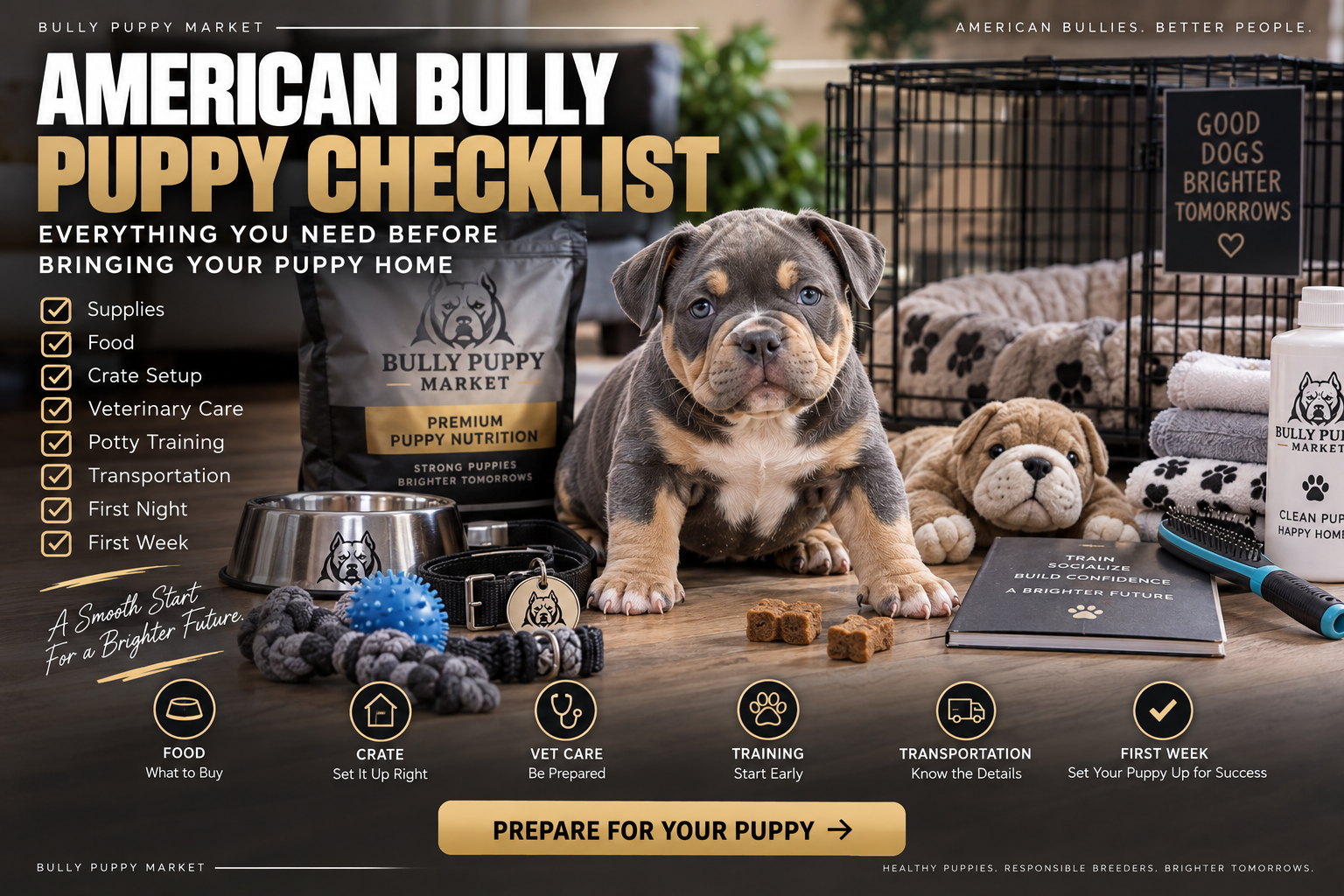
Bringing home an American Bully puppy is exciting—but the first few days are much easier when everything is prepared before your puppy arrives.
Food, a crate, veterinary care, identification, cleaning supplies, training equipment, puppy-proofing, and a predictable routine should ideally be in place before pickup day.
A good American Bully puppy checklist isn’t about buying every puppy product you see.
It’s about having the essentials needed to keep your puppy safe, comfortable, healthy, and prepared for the transition into a new home.
This guide covers what to prepare before bringing home an American Bully puppy, including:
- Puppy records
- Veterinary care
- Food and feeding supplies
- Crate and sleeping area
- Collar, leash, and identification
- Potty-training supplies
- Toys and enrichment
- Grooming supplies
- Puppy-proofing
- Transportation
- Training
- Socialization
- The first night
- The first week
- Questions to ask your breeder before pickup
If you’re still searching for your puppy, start by browsing American Bully puppies on Bully Puppy Market.
American Bully Puppy Checklist at a Glance
Before pickup day, make sure you have:
Documents and Health
☐ Purchase agreement
☐ Health guarantee
☐ Veterinary records
☐ Vaccination records
☐ Deworming records
☐ Registration information
☐ Pedigree information when applicable
☐ Microchip information when applicable
☐ Your veterinarian selected
☐ First veterinary appointment planned
Feeding
☐ Current puppy food
☐ Food bowl
☐ Water bowl
☐ Measuring cup
☐ Training treats
☐ Breeder’s feeding instructions
Home
☐ Crate
☐ Puppy bed
☐ Puppy-safe containment area
☐ Baby gates if needed
☐ Cleaning supplies
☐ Enzymatic cleaner
Walking and Identification
☐ Collar
☐ Leash
☐ Identification tag
☐ Appropriate harness if desired
Training and Enrichment
☐ Safe chew toys
☐ Interactive toys
☐ Training treats
☐ Potty-training plan
☐ Basic training plan
Grooming
☐ Dog shampoo
☐ Brush or grooming tool
☐ Nail-care supplies
☐ Towels
☐ Ear-care products recommended for your puppy
Transportation
☐ Safe travel crate or restraint
☐ Pickup/delivery details confirmed
☐ Water for longer trips
☐ Cleanup supplies
☐ Breeder contact information
You don’t need to purchase an entire pet store.
Start with the essentials and add products as you learn what your individual puppy needs.
Before You Buy Supplies, Talk to Your Breeder
One of the easiest mistakes new puppy owners make is buying everything before asking what the puppy is already accustomed to.
Before pickup, ask your breeder:
- What food is the puppy eating?
- How much is the puppy eating?
- How many meals per day?
- What feeding schedule is being used?
- Is the puppy accustomed to a crate?
- Has potty training started?
- What type of bedding has been used?
- What toys does the puppy like?
- What vaccinations have been given?
- When was the puppy last dewormed?
- Is the puppy microchipped?
- What records will come home?
- When is the next veterinary care due?
Keeping some routines familiar can make the transition easier.
If you’re still evaluating a puppy or breeder, use Questions to Ask Before Buying an American Bully Puppy before making your reservation.
1. Get Your Puppy Records Together
Your puppy should come home with whatever records and documentation apply to your purchase.
These may include:
- Purchase agreement
- Health guarantee
- Veterinary examination record
- Vaccination record
- Deworming history
- Medication information
- Registration paperwork
- Pedigree
- Microchip information
- Feeding instructions
Not every puppy will have every item.
Ask your breeder what you should expect to receive.
Create a physical folder or digital folder for these documents so they don’t get lost.
You’ll likely need some of them during your first veterinary visit.
2. Read the Health Guarantee Again Before Pickup
Ideally, you reviewed the health guarantee before purchasing.
Read it again before the puppy comes home.
Pay particular attention to any requirement that you have the puppy examined by a veterinarian within a specified period.
Missing that deadline could affect coverage under some breeder agreements.
Know:
- Examination deadline
- Covered conditions
- Exclusions
- Documentation requirements
- Buyer responsibilities
- Breeder responsibilities
- Procedure if a health concern is discovered
Don’t wait until a problem occurs to learn what the guarantee says.
For more information about breeder health practices and puppy veterinary care, read American Bully Health Testing and Puppy Care Explained.
3. Choose Your Veterinarian Before Your Puppy Arrives
Don’t wait until your puppy is home to begin searching for a veterinarian.
Select a veterinary clinic beforehand.
Ask:
- Are they accepting new patients?
- How soon can they see a new puppy?
- Do they provide puppy wellness care?
- What records should you bring?
- What is their process for after-hours emergencies?
Also identify the nearest appropriate emergency veterinary facility.
You may never need it.
But an emergency isn’t the ideal time to begin searching.
4. Schedule the First Veterinary Visit
Arrange your puppy’s first veterinary examination according to the breeder agreement and your veterinarian’s guidance.
Bring:
- Breeder veterinary records
- Vaccination history
- Deworming history
- Medication information
- Health guarantee
- Any questions you’ve noticed since pickup
Your veterinarian can review the puppy’s existing records and help establish the next steps for preventive care.
5. Buy the Food Your Puppy Is Already Eating
Pickup day usually isn’t the ideal time for an unnecessary diet change.
Ask the breeder for:
- Food brand
- Exact formula
- Amount per meal
- Meals per day
- Feeding times
Purchase enough before your puppy arrives.
If you eventually want to change foods, discuss an appropriate transition with your veterinarian.
A sudden change combined with the stress of moving into a new home can contribute to digestive upset.
For more American Bully puppy feeding and ownership information, visit the American Bully Puppy Resource Center.
6. Get Food and Water Bowls
Choose bowls that are:
- Stable
- Easy to clean
- Appropriately sized
- Durable
Stainless steel is a popular option because it’s durable and easy to clean.
Keep fresh water available according to your puppy’s needs and your veterinarian’s recommendations.
Wash food and water bowls regularly.
7. Use a Measuring Cup for Puppy Food
It’s easy to accidentally overfeed when food is poured by eye.
Keep a dedicated measuring cup or scoop with your puppy food.
Follow the breeder’s current feeding routine initially and discuss future adjustments with your veterinarian as the puppy grows.
American Bullies can have substantial builds, but excess body fat isn’t the same thing as desirable bone or muscle.
Appropriate body condition matters.
8. Choose an Appropriate Crate
A crate can become one of the most useful tools in your puppy setup.
It can help with:
- Sleeping
- House training
- Safe containment
- Travel
- Establishing a routine
Choose a crate large enough for the puppy to:
- Stand comfortably
- Turn around
- Lie down comfortably
But don’t automatically give a young puppy an enormous crate.
Many owners use an adult-size crate with an adjustable divider so the usable area can grow with the puppy.
The crate should be introduced as a safe resting area—not used as punishment.
9. Create a Dedicated Puppy Sleeping Area
Your puppy has just left:
- Mother
- Littermates
- Familiar smells
- Familiar people
- Familiar surroundings
The first nights may therefore involve restlessness or vocalizing.
Set up the sleeping area before the puppy arrives.
Choose somewhere:
- Safe
- Quiet enough for sleep
- Easy to monitor
- Away from dangerous objects
- Appropriate for nighttime potty trips
Consistency from the first night can help establish a routine.
10. Choose a Washable Puppy Bed
Puppies have accidents.
They chew.
They spill water.
They sometimes get sick.
Your first puppy bed doesn’t need to be luxurious.
Look for something:
- Washable
- Durable
- Appropriately sized
- Easy to replace if necessary
Monitor puppies with bedding if they’re prone to tearing or swallowing fabric.
Safety matters more than appearance.
11. Use Baby Gates or Puppy Pens When Needed
A puppy doesn’t need immediate access to your entire home.
A smaller controlled environment can make supervision easier.
Baby gates or puppy pens can help create safe boundaries around:
- Kitchens
- Stairs
- Bedrooms
- Children’s areas
- Other pets
- Rooms containing hazards
You can gradually increase access as the puppy develops better household habits.
12. Puppy-Proof Your Home
Think like a curious puppy.
Anything within reach may become something to investigate with the mouth.
Before pickup, secure:
- Electrical cords
- Medications
- Cleaning chemicals
- Trash
- Small objects
- Children’s toys
- Shoes
- Food
- Houseplants that may be unsafe
- Loose fabric
- Accessible wires
- Anything easily swallowed
Check underneath furniture too.
Puppies can reach places adults overlook.
13. Puppy-Proof Your Yard
If your puppy will use a yard, inspect it beforehand.
Check:
- Fence gaps
- Loose gates
- Sharp objects
- Toxic plants
- Chemicals
- Standing water
- Tools
- Small objects
- Areas where the puppy could escape
Don’t assume a fence designed for an adult dog will contain a small puppy.
14. Choose a Proper Collar
Buy a collar appropriately sized for your puppy.
You should be able to adjust it as the puppy grows.
Check fit frequently.
American Bully puppies can grow quickly, and a collar that fit several weeks ago may become too tight.
Avoid buying an expensive adult collar for a very young puppy unless it’s highly adjustable.
You’ll likely replace it.
15. Buy a Standard Leash
A basic leash is sufficient for beginning leash work.
Choose something:
- Comfortable to hold
- Strong enough for the puppy
- Easy to control
- Appropriate in length
Your puppy doesn’t need elaborate walking equipment on day one.
The most important thing is beginning calm, positive leash exposure.
16. Consider a Harness
Some owners prefer a harness for certain activities.
If you use one, make sure it:
- Fits properly
- Doesn’t restrict movement
- Doesn’t rub
- Can’t easily be backed out of
Your puppy will grow.
Check fit frequently.
A harness doesn’t replace leash training.
17. Get an Identification Tag
Once appropriate, identification should include current contact information.
At minimum, consider:
- Owner phone number
- Puppy name if desired
If your puppy is microchipped, make sure the registration information is completed and remains current.
A microchip only helps if the associated contact information can connect the dog back to you.
18. Buy Safe Chew Toys
Puppies explore with their mouths.
Teething increases the desire to chew.
Have several appropriate chew options available before the puppy arrives.
Choose toys suited to:
- Puppy age
- Size
- Chewing strength
Inspect toys regularly.
Discard damaged toys that could become choking or ingestion hazards.
Supervise new toys until you understand how your puppy uses them.
19. Add Interactive Toys
Not every toy needs to be designed purely for chewing.
Interactive toys can help provide:
- Mental stimulation
- Food enrichment
- Training opportunities
- Appropriate independent activity
Rotate toys rather than leaving every toy available all the time.
Rotation can help keep familiar toys interesting.
20. Buy Training Treats
Small training treats can be useful for teaching:
- Name recognition
- Recall
- Sit
- Crate entry
- Leash behavior
- Potty habits
- Calm behavior
Keep treats small.
Training can involve many repetitions, and treat calories add up.
Some puppies can also work for pieces of their normal food.
21. Prepare for Potty Training Before Day One
Don’t wait for the first accident to decide how potty training will work.
Determine:
- Which door you’ll use
- Where the puppy should eliminate
- Who handles nighttime trips
- How frequently you’ll take the puppy out
- What cue you’ll use
- How you’ll reward success
Young puppies often need opportunities after:
- Waking
- Eating
- Drinking
- Playing
- Training
- Excitement
- Before bed
Consistency matters more than perfection.
22. Buy an Enzymatic Cleaner
Accidents will probably happen.
An enzymatic pet cleaner can help break down organic material and reduce lingering odor.
Ordinary household cleaner may make an area smell clean to you while leaving odor traces detectable to the puppy.
Keep cleaning supplies accessible to adults but safely away from the puppy.
23. Don’t Punish Potty Accidents
House training requires repetition.
If you catch the puppy beginning to eliminate in the wrong location, calmly redirect when practical.
Reward appropriate elimination.
Punishment after an accident doesn’t teach the puppy where you wanted it to go.
Build the routine you want repeated.
24. Start With a Simple Grooming Kit
American Bullies generally don’t require complicated coat maintenance.
A basic puppy grooming setup can include:
- Appropriate brush
- Dog shampoo
- Towels
- Nail-care tool
- Ear-care supplies if recommended
- Dog toothbrush
- Dog toothpaste
Human grooming products aren’t automatically appropriate for dogs.
Use products intended for canine use or recommended by your veterinarian.
25. Introduce Grooming Early
Don’t wait until your dog is large and powerful to begin handling exercises.
Gently help your puppy become comfortable with:
- Paws being touched
- Nails being handled
- Ears being checked
- Mouth being examined
- Brushing
- Bathing
- Toweling
Keep early sessions short and positive.
These habits can make future grooming and veterinary care easier.
26. Start Dental Care Early
Dental care is easy to postpone.
Beginning early can help make tooth brushing normal.
Use:
- Dog-safe toothbrush
- Dog toothpaste
Never use human toothpaste unless your veterinarian specifically says the product is safe for dogs.
Ask your veterinarian about an appropriate dental-care routine.
27. Prepare for the Ride Home
Pickup day is already a major change for your puppy.
Make transportation as safe and calm as practical.
Depending on the trip, prepare:
- Secure crate or appropriate restraint
- Towels
- Waste bags
- Paper towels
- Water
- Cleanup supplies
- Puppy records
- Breeder contact information
For longer journeys, discuss travel needs with the breeder and veterinarian.
28. Confirm Transportation Before Pickup Day
If you’re not personally collecting the puppy, make sure transportation details are settled in advance.
Confirm:
- Transport method
- Date
- Pickup location
- Delivery location
- Person responsible
- Contact information
- Cost
- Required documents
Don’t leave major transportation questions until the last minute.
29. The First Hour at Home
When your puppy arrives, avoid turning the moment into a party.
Your family may be excited.
The puppy has just experienced a major transition.
Start calmly.
Take the puppy to the designated potty area.
Then allow controlled exploration of a small portion of the home.
Show the puppy:
- Water
- Sleeping area
- Crate
- Safe puppy area
Keep the environment manageable.
There will be plenty of time for introductions.
30. The First Night With Your American Bully Puppy
The first night may not be quiet.
Your puppy may:
- Whine
- Wake frequently
- Need potty breaks
- Seem unsettled
- Look for littermates
This doesn’t automatically indicate a problem.
The environment is completely new.
Keep the routine calm and predictable.
Take the puppy out for necessary potty breaks, then return to the sleeping routine rather than turning nighttime into playtime.
31. Establish a Daily Routine
Puppies benefit from predictability.
Your routine can include:
Wake → Potty → Meal → Potty → Play/Training → Potty → Rest
Then repeat throughout the day as appropriate.
A schedule helps you anticipate:
- Potty needs
- Hunger
- Sleep
- Training
- Activity
Young puppies need substantial sleep.
Don’t assume constant activity is beneficial.
32. Start Training Immediately—but Keep It Simple
Training begins the moment the puppy enters your home.
You’re already teaching:
- Where to sleep
- Where to potty
- How to interact with people
- What can be chewed
- What happens around food
- How attention is earned
Early formal training can remain simple.
Useful first skills include:
- Name recognition
- Come
- Sit
- Crate
- Handling
- Leash introduction
- Calm attention
Use short sessions.
33. Everyone in the Household Should Follow the Same Rules
Inconsistency makes puppy training harder.
Before the puppy arrives, decide:
- Is the puppy allowed on furniture?
- Where does the puppy sleep?
- Who feeds the puppy?
- What words will be used for commands?
- Which door is used for potty trips?
- How will jumping be handled?
- What behaviors earn attention?
If one person rewards something while another discourages it, learning becomes less clear.
34. Socialization Is More Than Meeting Dogs
Socialization isn’t simply allowing your puppy to play with every dog it encounters.
Thoughtful puppy development can include positive exposure to:
- Different people
- Household sounds
- Surfaces
- Handling
- Car rides
- Appropriate environments
- Everyday objects
- Calm new experiences
Exposure should be appropriate for the puppy’s age, vaccination status, and individual confidence.
Ask your veterinarian about disease risk in your area before taking an incompletely vaccinated puppy into environments frequented by unknown dogs.
35. Don’t Overwhelm the Puppy
More exposure isn’t automatically better.
A frightened puppy forced into an overwhelming experience isn’t necessarily receiving useful socialization.
Watch body language.
Allow the puppy to process new experiences.
Build confidence gradually.
Quality matters more than checking off the largest possible number of experiences.
36. Introduce Children Carefully
Children and puppies can become wonderful companions, but both need guidance.
Teach children:
- Don’t climb on the puppy
- Don’t pull ears or tail
- Don’t disturb the puppy while sleeping
- Don’t take food away
- Don’t corner the puppy
- Don’t treat the puppy like a toy
Supervise interactions.
Puppies also need a quiet area where they can rest undisturbed.
37. Introduce Other Dogs Thoughtfully
Don’t simply place the new puppy in front of the resident dog and hope everything works out.
Consider:
- Resident dog’s temperament
- Age
- Size
- Resource guarding
- Health
- Puppy energy level
Use controlled introductions and supervision.
Separate food and high-value items initially when appropriate.
Give the resident dog breaks from the puppy.
38. Introduce Cats Carefully
A successful puppy-cat household often depends on management.
Give the cat:
- Escape routes
- Elevated spaces
- Puppy-free areas
Keep early interactions controlled.
Don’t allow the puppy to repeatedly chase the cat.
Teach calm behavior from the beginning.
39. Monitor Exercise in a Growing Puppy
Puppies need activity, but more isn’t always better.
A growing puppy isn’t a miniature adult athlete.
Avoid assuming a muscular breed needs intense exercise from an early age.
Appropriate activity can include:
- Play
- Short training sessions
- Age-appropriate walks when appropriate
- Exploration
- Mental enrichment
Discuss exercise with your veterinarian, especially during rapid growth.
40. Watch Your Puppy Closely During the First Week
The first week gives you a baseline for what’s normal for your individual puppy.
Observe:
- Appetite
- Water intake
- Stool
- Urination
- Energy
- Sleep
- Breathing
- Movement
- Behavior
Contact your veterinarian if something concerns you.
Young puppies can change quickly.
41. Don’t Change Everything at Once
Your puppy is already dealing with:
- New home
- New people
- New smells
- New sleeping area
- New routine
- Separation from littermates
When practical, avoid simultaneously changing:
- Food
- Feeding schedule
- Sleeping routine
- Every household expectation
Introduce necessary changes thoughtfully.
42. Know Your Breeder’s Contact Information
Keep breeder contact details readily available.
Questions may arise about:
- Food
- Previous routines
- Registration
- Veterinary records
- Pedigree
- Contract
- Microchip
- Puppy habits
A breeder who knows the litter may be able to provide useful background.
If you’re still selecting a breeder, read How to Find a Responsible American Bully Breeder.
43. Budget Beyond the Puppy Purchase Price
Buying the puppy isn’t the end of the expense.
Initial and ongoing costs can include:
- Veterinary care
- Food
- Crate
- Bedding
- Training
- Toys
- Grooming
- Parasite prevention
- Identification
- Transportation
- Emergency care
Before purchasing, understand both the puppy price and the cost of ownership.
For a detailed explanation of pricing factors, read How Much Does an American Bully Puppy Cost?.
What You Don’t Need on Day One
New owners sometimes overspend before they know what their puppy actually likes or needs.
You probably don’t need:
- Ten beds
- Twenty toys
- Multiple expensive collars
- Large quantities of treats
- Complicated training equipment
- Every supplement advertised online
- An entire adult wardrobe
- Large amounts of a new food
Start with quality essentials.
Learn your puppy.
Then add items based on actual needs.
American Bully Puppy Pickup-Day Checklist
Before leaving to get your puppy:
☐ Confirm pickup time
☐ Confirm address/location
☐ Confirm remaining balance
☐ Confirm accepted payment method
☐ Bring safe transportation setup
☐ Bring towels
☐ Bring cleanup supplies
☐ Bring water if needed
☐ Have breeder contact information
☐ Confirm records you’ll receive
☐ Confirm registration information
☐ Confirm feeding instructions
☐ Confirm current food
☐ Confirm last meal
☐ Confirm last vaccination/deworming
☐ Review health guarantee
☐ Review purchase agreement
Before leaving with the puppy, make sure you haven’t forgotten the paperwork.
First 24 Hours Checklist
Once home:
☐ Take puppy to potty area
☐ Offer water
☐ Introduce small safe area
☐ Keep household calm
☐ Feed according to existing routine
☐ Begin potty schedule
☐ Introduce crate calmly
☐ Limit overwhelming visitors
☐ Monitor appetite
☐ Monitor stool and urination
☐ Allow plenty of sleep
☐ Prepare for nighttime potty trips
The goal isn’t to show the puppy everything in your home on day one.
The goal is to begin building security and routine.
First Week Checklist
During the first week:
☐ Complete veterinary examination as required
☐ Review vaccination schedule
☐ Review parasite prevention
☐ Continue feeding routine
☐ Begin basic training
☐ Continue crate introduction
☐ Establish potty routine
☐ Begin gentle handling exercises
☐ Introduce grooming
☐ Begin age-appropriate socialization
☐ Monitor health and behavior
☐ Update microchip information if applicable
☐ Organize puppy records
☐ Contact breeder with relevant questions
A successful first week is mostly about consistency.
American Bully Puppy Supply Checklist
Essential Before Arrival
☐ Puppy food
☐ Food bowl
☐ Water bowl
☐ Crate
☐ Bedding
☐ Collar
☐ Leash
☐ ID tag
☐ Safe chew toys
☐ Training treats
☐ Waste bags
☐ Enzymatic cleaner
☐ Basic grooming supplies
Useful Depending on Your Home
☐ Puppy pen
☐ Baby gates
☐ Harness
☐ Car restraint
☐ Travel crate
☐ Interactive toys
☐ Food enrichment toys
☐ Storage container for food
☐ Dedicated puppy towel
Purchase as Needed
☐ Additional grooming tools
☐ Training equipment
☐ Travel accessories
☐ Additional beds
☐ Specialized feeding equipment
☐ Veterinarian-recommended products
If You Haven’t Chosen Your Puppy Yet
Preparation is important.
Choosing the right puppy comes first.
Before reserving, research:
- Puppy
- Sire
- Dam
- Pedigree
- Health information
- Breeder
- Price
- Deposit
- Contract
- Health guarantee
- Transportation
Start with American Bully Puppies for Sale: Complete Buyer’s Guide for the complete buying process.
If you’re specifically looking for a compact American Bully, continue with Micro Bully Puppies for Sale: Complete Buyer’s Guide.
You can also browse available puppies on Bully Puppy Market.
Frequently Asked Questions About Preparing for an American Bully Puppy
What do I need before bringing home an American Bully puppy?
At minimum, prepare the puppy’s current food, food and water bowls, crate, safe sleeping area, collar, leash, identification, safe toys, cleaning supplies, grooming basics, veterinary arrangements, and a potty-training plan.
Should I change my American Bully puppy’s food when I bring it home?
It’s generally useful to know what the puppy is currently eating and avoid unnecessary sudden changes during an already significant transition. Discuss any dietary change with your veterinarian and transition appropriately.
What size crate should I buy for an American Bully puppy?
The puppy should be able to stand, turn around, and lie down comfortably. An adult-size crate with a divider can allow the usable space to expand as the puppy grows.
Should I take my new puppy to the veterinarian?
Establish care with your own veterinarian. Your breeder’s health guarantee may also require an examination within a particular period, so review your agreement.
What should the breeder give me when I pick up my puppy?
Depending on the breeder and purchase, documents may include veterinary records, vaccination and deworming information, registration paperwork, pedigree information, purchase agreement, health guarantee, microchip information, and feeding instructions.
What should I do the first night with my American Bully puppy?
Keep the environment calm, establish the sleeping location, provide necessary potty opportunities, and begin a predictable nighttime routine. Some whining or restlessness can occur while the puppy adjusts.
When should I start training my American Bully puppy?
Learning begins immediately. Start with simple routines such as name recognition, potty training, crate introduction, handling, recall, and calm attention using short, age-appropriate sessions.
How often should an American Bully puppy go outside to potty?
Young puppies generally need frequent opportunities, particularly after waking, eating, drinking, playing, training, and before sleep. Individual needs vary.
Do American Bully puppies need lots of exercise?
Puppies need appropriate activity, play, training, and mental stimulation, but a growing puppy shouldn’t be treated like an adult athlete. Ask your veterinarian about age-appropriate exercise.
Should I buy supplements for my American Bully puppy?
Don’t assume a puppy needs supplements because they’re heavily marketed. Start with an appropriate complete diet and discuss supplements with your veterinarian before adding them.
Preparation Makes the Transition Easier
Your puppy doesn’t need a perfect home on the first day.
It needs a prepared home.
Focus on the fundamentals:
Safe environment.
Appropriate food.
Veterinary care.
Predictable routine.
Potty training.
Rest.
Positive training.
Age-appropriate socialization.
Patience.
The puppy is learning an entirely new life.
Your preparation allows you to spend less time scrambling for supplies and more time helping your new American Bully settle in.
Find Your American Bully Puppy
Still searching for the puppy you’ll eventually bring home?
Browse American Bully Puppies on Bully Puppy Market
Before reserving a puppy, continue with these buyer resources:
How to Find a Responsible American Bully Breeder
Questions to Ask Before Buying an American Bully Puppy
How Much Does an American Bully Puppy Cost?
American Bully Health Testing and Puppy Care Explained
Micro Bully vs Pocket Bully: Which Is Right for You?
American Bully Puppies for Sale: Complete Buyer’s Guide
Micro Bully Puppies for Sale: Complete Buyer’s Guide
For more detailed puppy feeding, training, potty training, socialization, and development guidance, continue to the American Bully Puppy Resource Center.